

Trusted pensions advice from Wrigleys Solicitors
Wrigleys’ Pensions Team offers quality, risk-based advice which is tailored to the needs of our clients. We have a strong team of lawyers providing an efficient service at competitive rates.
Pensions law advisers to employers and trustees
Although long renowned as a team of choice for trustees, Wrigleys' Pensions Team also advises scheme employers, public sector bodies, charities and educational establishments.
Small scheme specialists
Our clients range from schemes with assets of less than £1m to over £100m. Regardless of the size of pension scheme, our approach centres on the provision of pragmatic, commercial advice. Our reputation and expertise means that we are regularly instructed on complex, technical and high value issues.
Value for money
Many of our pensions lawyers come from larger national firms. A lower cost base allows Wrigleys to match the expertise of national and city firms at competitive rates.
We understand that smaller schemes face the same legal requirements and financial challenges as larger ones. We find that trustees and employers of smaller schemes can struggle to find high quality, affordable advice. Please contact us to discuss our approach and proposals to match your needs and budget.
The Wrigleys' Pensions Team, known for their specialized, pragmatic and commercial advice to a diverse clientele, offers quality, risk-based advice tailored to suit the unique needs of trustees, scheme employers, public sector bodies, charities, and educational establishments. To stay informed about the latest developments, insights, and trends in the pensions sector, we invite you to visit our Pensions News section.
'The team at Wrigleys are very easy to work with. Their knowledge in their field is clear and they are happy to discuss issues and collaborate to come up with pragmatic solutions.'
Legal 500 (2026)
‘Wrigleys has detailed knowledge of the relevant legislation combined with an ability to translate this into advice which is easy to understand.’
Chambers and Partners (2026)



Pensions Team Bulletin March 2023

Changes to the Notifiable Events Regime
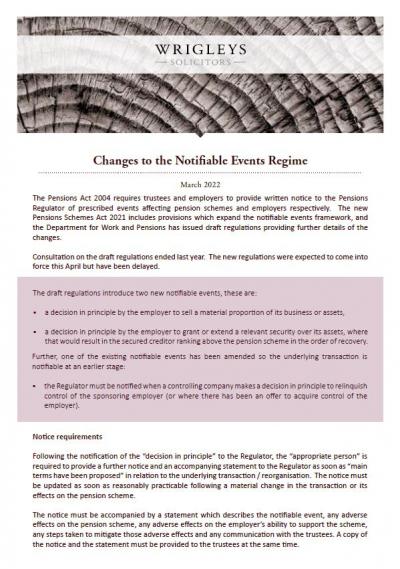
New statutory transfer conditions in force from 30 November 2021
Pensions Team Bulletin Autumn 2021

Pensions Team Bulletin December 2020
Pensions Team Bulletin October 2020
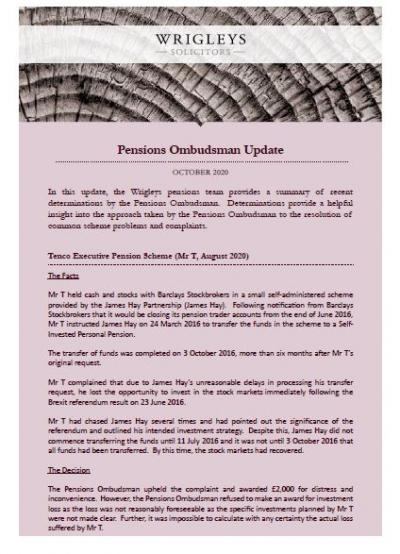
Pensions Team Bulletin September 2020

Pensions Team Bulletin July 2020

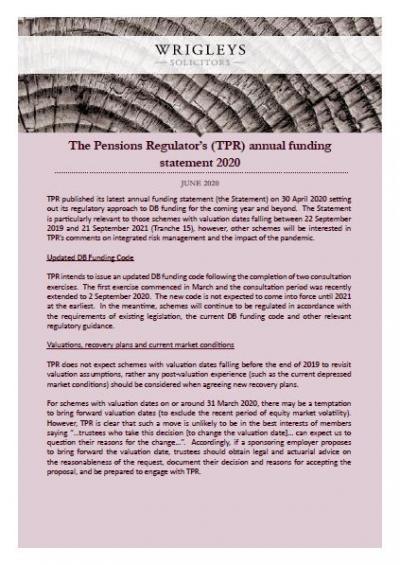
The Pensions Regulator’s (TPR) annual funding statement 2020
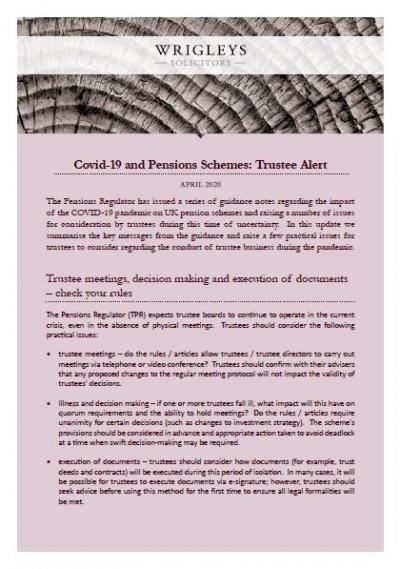
Covid_19 and Pensions: Trustee Alert
Pensions Team Trustee Agenda Qtr 1